 Log in



|
department of hack
|

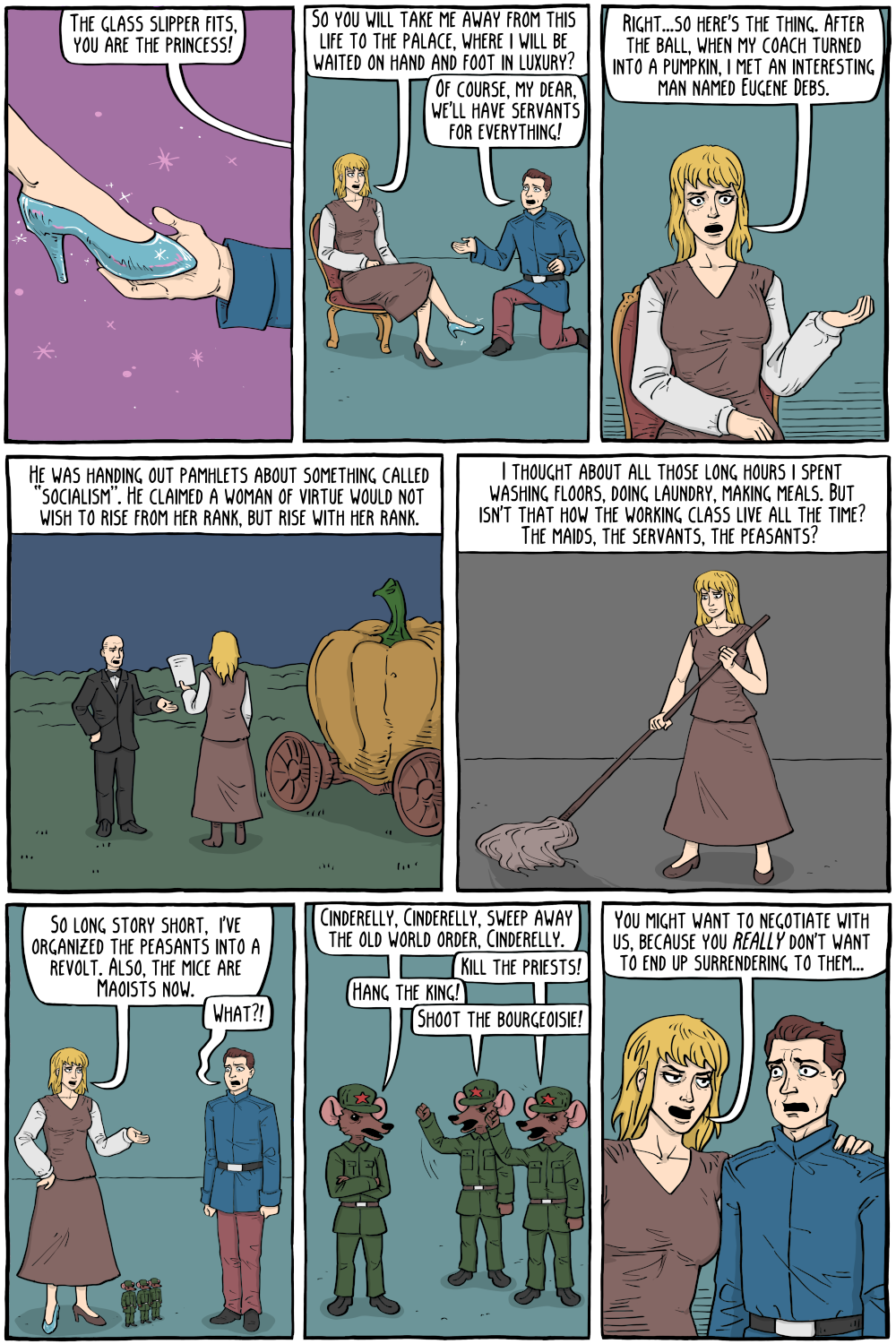
Something something "Of Mice and Maos"
Boulder, CO

1 public comment


When Beane expanded the plot of Rogers and Hammerstein's Cinderella to a full Broadway play, he actually added a communist revolution subplot. One of Cinderella's stepsisters ends up marrying the revolutionary.
Columbia, MD


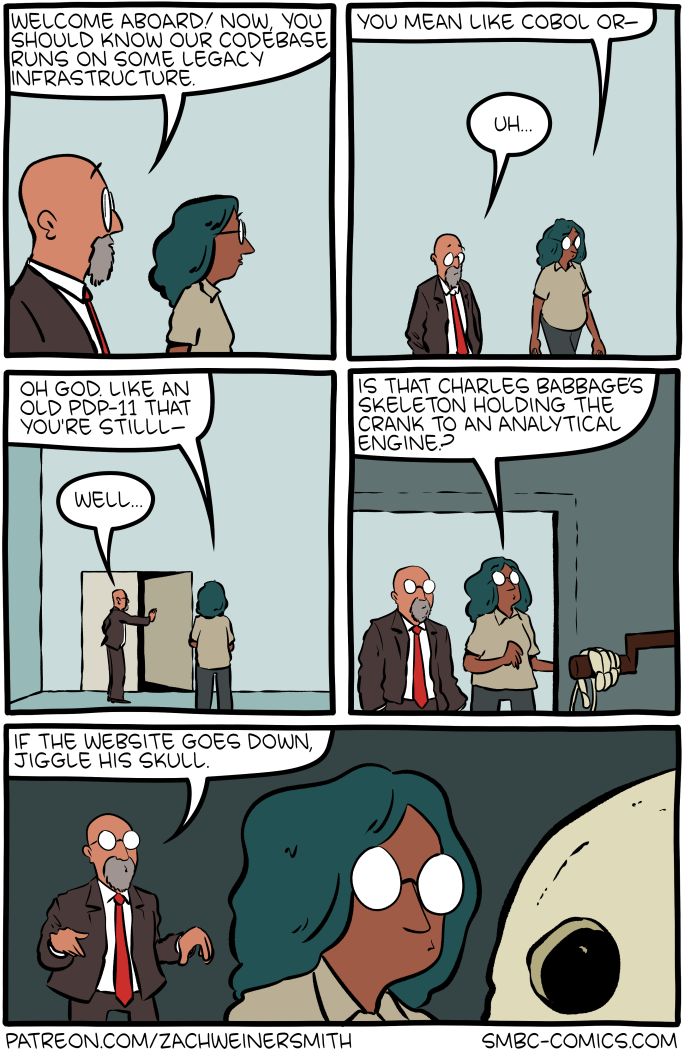
Click here to go see the bonus panel!
Hovertext:
And when Babbage arrived the whole thing was actually running on a series of Pascalines.
Today's News:
 reply
reply
Boulder, CO

...in 70mm IMAX!
I kind of regret it. I saw it at the Chinese Theater in Hollywood - like, real downtown Hollywood, the part of Hollywood with the stars on the sidewalk and the smelly guys in Spiderman outfits. The picture in the theater was massive but the audio in that theater is pretty crazy, and the movie is full of deep, rumbly sounds which swallowed the entire mix and made it impossible to hear what anyone was saying clearly.
That rumbling is sometimes supposed to be thunder, and it's often relevant to the conversation or to the decisions the characters make, because they take it as a sign from Zeus that he approves or disapproves of things happening in the scene. I didn't realize this until halfway through the movie because I could not tell that it was thunder! It was just boneshaking growling to me.
Anyway, that's my first big complaint out of the way - I think I need to see this movie again in non-IMAX, because I think I'd enjoy it more if I could hear what everyone was saying. I did enjoy it! I had a great time. I think it's a great movie.
There's been a lot of hay made about adaptation and the Odyssey's choices in adaptation. I actually think it's good for the movie to be so 2026 in its choices. There's no point in pretending like your adaptation says nothing, or in pretending like you aren't present inside it. The movie embraces being an adaptation and it embraces the attempt to wedge a modern thematic arc into an ancient story. This work is essential, I think, if you're going to make big budget shit. Adaptation which takes the present moment into account is why we still know and care about ancient myth.
The movie seems aware of the burden and opportunity associated with making a massive-budget summer blockbuster out of it. It feels like Nolan is aware that he was making the most 2026 Odyssey ever, and that if he did a good job, this could stand a good chance of becoming one of the things we point to in the future when we want to talk about what the mid-2020s were like. It's Trauma Odysseus. Why not? Making Trauma Odysseus says something about who we are today.
I thought Damon was a great choice in the end. I struggled with Jon Bernthal Menelaus, partially because he seems like he's just playing the same guy he always does, but I bought him in the end, too. Anne Hathaway is great. Robert Pattinson is doing his Goblin Man deal again after Mickey 17, and this is also great. John Leguizamo is a ton of fun. They really juice the big important moments, and everyone is acting their butts off, and it's very inspiring and fun to think about how this story has affected all the storytelling I've ever known. All the movie shit that feels like Movie Shit is actually just from the Odyssey. Coming out of the theater, my friends and I were going over how most of the moments which feel Hollywood in this story - the reunions, the twists, the fuckin dog - are just original to the story. Storytelling is so cool!!!
One thing I did not enjoy about the story was the fact, however, that all the characters keep discussing the Bronze Age collapse and the Sea Peoples. I admire and again think it's important to try wedging a modern thematic arc into your adaptations, but this one felt like a miss to me. Odysseus is Odysseus. He is not a 20th century scholar. He should not be discussing the Sea Peoples using the phrase "the sea people."
You can keep that shit if you rephrase it! He could say, "Wow, it feels like the world is getting more violent and dangerous. We constantly hear stories about people coming to pillage and kill from the ocean. That's so crazy. Can those people even read? Ever since the Trojan War it feels like society is falling apart." But saying "the sea peoples" in a movie like this feels like hitting me in the head with a frying pan. I don't like it!
Anyway, strong recommend. Watch the movie! It's fun! I think I might see it a second time!! I might even read the Odyssey. I read the Illiad in 6th grade, I read all the boat chapters because nobody told me it was okay to skip them, but I've never read a translation of the Odyssey. I took Latin for six years in middle school and high school but all of that is slipping out of my soup brain now that I'm old. I should know about this shit! It's fun to know about!
Boulder, CO


Saw Nolan’s Odyssey and also had my first author event in Colombo, an interview at Lakmahal Community Library in Bambalapitiya. The two things are not especially connected, except that they happened on the same day, and I cited the former briefly at the latter to talk about its disenchantment and the discomfort it indicates. And I suppose I could say it’s been a long twisty road from my first publication to my first author event in my own city, but that would be too on the nose.
Speaking of being on the nose, Nandini and I saw the film at Havelock City in “IMAX with laser”, which, while excellent—I am not much of a films guy and I am happy to be impressed— is not the IMAX 70mm that it was famously shot in and demands to be seen in. There are no IMAX 70mm theatres in Sri Lanka, obviously, since there are none in the entire third world and not that many in the first, either. Much like the Bronze Age culture whose collapse and consequent technological loss is depicted so on-the-nosily in The Odyssey, IMAX 70mm projectors are a lost technology belonging to a dead civilization. No new 70mm projectors have been built in my lifetime; the ancient aliens who built this technology are long gone, leaving us to marvel at how one cannot even slip a bare bodkin between the pixels. This seems fitting for a fantastic spectacle that isn’t fantastical at all.
“Our Age of Bronze is ending,” Odysseus says at one point, distinctly pronouncing the capital letters while staring into the distance like a soap opera character. It is a film deeply concerned that it’s too smart for you: it explains to you that it is a sapiosexual, actually. There is a visible concern that you might not be getting it. The gods (as characters who have their own motivations and dialogues) are excised from the story entirely and all fantastical elements are contained within a frame of mimetic psychologism. Athena is a hallucination derived from guilt, and in case that was not clear, all her brief dialogue is about putting divinity in its place as allegory for nature, human and otherwise. It is evident that gods are fictions, as they are under modernity. Polyphemus and the other fantastical events of the journey are only stories told by an amnesiac, lotus-addicted Odysseus to Calypso, who here is therapist rather than rapist. The stories of the fantastic are hazily recovered memories and so easily readable as being distortions or delusions. The “real” story is simply that a soldier with PTSD from committing war crimes—Odysseus as the conventional American war movie protagonist—chooses a life of banditry over going home until healed through psychotropic medication and talk therapy. He also destroys his whole civilization through the violation of its fragile taboos, but it’s all right because he is also not funny. He is not twisty at all but a straightforward man: glum, realpoliticky, dimly honourable. He is only sad about the horrors that he himself perpetrated with malice aforethought.
I disliked Spidermachus and Punisherlaus primarily because I don’t feel like either of them can really act beyond their typecast Marvel roles. Their scene together is difficult to not eyeroll at. Helen was great, Clytemnestra too, though I was not super enthused about them being identical twins rather than half-sisters; I feel like that sabotages Menelaus’s postwar scarring of Helen, which is an actually good Nolan innovation, and certainly this Menelaus is convincing as the incel podcast bro who would. I was hugely entertained by large twink Agamemnon and his Darth Vader shtick. I thought Polyphemus looked great; the twisted-face version is visually striking and oddly compelling as a cyclops who is a unique mutant (no Jean Grey to save him here) rather than a member of a Cyclopean civilization, which is in any case absent in this film. If anything, the psychologistic reading suggests that the whole episode is a distorted memory of murdering a disabled civilian shepherd, which is in keeping with this American Sniper Odysseus. Circe’s body-horror scene was wonderful and I would watch a whole spinoff of this Circe and her crow sister, though her interaction with Odysseus was rushed and lacklustre. I’m not clear who the crow sister is supposed to be: Circe’s sister Pasiphaë is the monsterfucker who will birth the Minotaur, but I don’t see what she’d have to crow about. I’m pleased that the blood pool in the underworld made it to the film, that was always one of my favourite bits. Scylla and Charybdis, unfortunately, were already too long in the tooth as a just-war metaphor, and cannot but feel like belabouring the point. I didn’t like that Matt Damon doesn’t beg and weep when he is tied to the mast and listening to the sirens: he only screams, masculinely and virilely. Odysseus needed to be crying more. Penelope was great, especially her bit about how the empty throne of Ithaca had never been empty. As was Antinous, who has a much extended role and carries off being a comic villain very well. As Nolan films go—and here I will say outright that I am a medium-grade Nolan hater, and only really rate The Prestige and I suppose Memento: I particularly loathed Tenet and Interstellar, and feel that the Bat-movies were forgettable except for Heath Ledger—this is one of the better ones. I find the realist/psychological interpretation grating as an approach, but on its own terms it’s well done here. As an entry in the long-established genre of Matt Damon Is Lost And Trying To Get Home movies (Interstellar again; The Martian; Saving Private Ryan; probably Dogma; I must be forgetting at least a couple—I usually include The Great Wall, too, in the spirit of the thing) this is probably the ultimate and newly canonical example.
As Nandini pointed out when we were talking about the film later, much of the original is also told in flashback, as a story told within the story. The difference, I think, is that in the text, when Odysseus is telling the story of his exploits to Alcinous, we have already seen a lot of divine intercourse and activity directly shown in the narrative, and there is no reason to doubt the supernatural. For instance, the gods have directly interfered in Calypso’s abduction of Odysseus and forced her to release him. This is in the text, including his unwillingness to be with her, but of this alone Odysseus does not tell Alcinous, saying only that she was very kind to him and offered him immortality, but that he refused. Nor has he lost his memory or become addicted to the lotus at any point: if he distorts this tale in the telling it is only for glory or out of shame, which he very well might do, but at least it would be on purpose.
I’ve been thinking, most of all, about this discomfort with fantasy and the way it fits alongside the comfort with the “realism” of war criminal guilt, a key American cultural trait, as apple pie as Telemachus saying mom and dad. The problem with “let’s treat the supernatural as allegory instead of extraneous woo-woo shit” is that the supernatural was already allegory, and in fact it was the source of the story’s power and endurance. Even if you went the whole hog, as Circe would say, and cast a trident-wielding Willem Defoe (and isn’t it weird that we got this in Aquaman of all places) to play Poseidon and rant in the middle of a thunderstorm about Odysseus mistreating his son, that is already a character story about rage and pride and vindictiveness, which are surely properties that a maritime culture would read out of the sea, but also about mirroring those same qualities in Odysseus himself—it’s his pride that leads him to name himself to Polyphemus in the end, rather than continuing with his anonymous subterfuge. None of that happens in the movie: Odysseus says nothing to Polyphemus, and it is uncertain whether that grim creature even has language (or the cyclops, either.) To give the ocean a name and a personhood is a literary technique, and to simply treat Poseidon’s curse as a baseless but self-fulfilling superstition held by the sailors (but not by Odysseus, the modern man) feels less like gritty realism and more like simple distrust of the techniques that were originally key to story that you are telling. I know Nolan could not possibly have made the film of The Odyssey that I would have most wanted to see; his idea of visual poetry was Interstellar and I found it unwatchable. I am entertained by this film and I find it interesting to think about; I am also disappointed that it was so fearful of the journey and never leaves the familiar shore.

Boulder, CO
Review: The Player of Games, by Iain M. Banks
| Series: | Culture #2 |
| Publisher: | HarperPrism |
| Copyright: | 1989 |
| Printing: | February 1987 |
| ISBN: | 0-06-105356-2 |
| Format: | Trade paperback |
| Pages: | 295 |
The Player of Games is political space opera and the second book in the shared Culture setting. As with most Culture books, the reading order is not particularly important. It won the 1989 Locus Award for best science fiction novel and sometimes competes with Use of Weapons as the consensus best Culture novel.
This review is a re-read and yet another experiment in how to re-review a book. This time, I decided to write a full second review with substantial spoilers so that I can talk in more detail about the book. If you want to avoid spoilers, or just want to see how my thoughts have evolved from my first reading, see my original review from 2005.
Gurgeh plays games. He is probably the best strategy game player in the entirety of the galaxy-spanning Culture. He has written papers on game theory, won innumerable major championships, and is a celebrity in the circle of like-minded aficionados.
Gurgeh is also bored and in the middle of the Culture equivalent of a mid-life crisis. As the story opens, he's vaguely unsatisfied and adrift, unenthused by his normal activities, and searching vaguely for something that will break through his ennui. He is caught by surprise by the thrill he gets from a moment's misunderstanding in which an opponent suspects him of cheating, which sets him up to be (apparently) clumsily blackmailed by a deeply unpleasant drone named Mawhrin-Skel.
SPOILERS BELOW. If you have not read this book, consider stopping here and instead reading my original no spoiler review.
The first hundred pages of The Player of Games is a slow, somewhat plodding introduction to Gurgeh, his social circle, and life in (one part of) the Culture. I remember being fascinated by this part the first time I read this book. It was only the second Culture novel I read and the first set in the Culture proper, so the world-building underlying this odd post-scarcity utopia on a vast intelligent habitat with sentient drones, complex privacy rules, endless cocktail parties, and apparently directionless socialites was intriguingly unlike the other science fiction I was reading at the time. This time through, I have to admit I was less impressed.
Gurgeh is not very likable, and his desultory mid-life crisis is a little boring. None of his friends have enough depth to appear as more than side notes, in part because Gurgeh doesn't seem to care enough about any of them to make them interesting to the reader. I've since read seven other Culture novels, so Banks's cocktail parties hold less charm and I was impatient for the real action to begin.
These chapters are still important, though, because they establish how utterly average Gurgeh is. He has one unique talent, a deep affinity with and obsession with strategy games, and is otherwise a bit of a depressed narcissist with a few casual relationships, a friend that he barely confides in, and a comfortable and familiar life. He is not in any way a hero or a charismatic figure; he just happens to be exceptionally good at one thing, enough to make him famous among people who care about that one thing and probably unknown to anyone else apart from the occasional idly perused news headline. He is the Culture's equivalent of the world chess champion.
The Contact division of the Culture has a problem. The Empire of Azad in the Lesser Magellanic Cloud is a nasty, expansionist culture of the sort that Contact would like to deal with before it causes broader problems. The Culture's normal approaches are thwarted by an unusual organizing principle: The empire is built around and takes its name from the game of Azad, a highly complex strategy game developed over thousands of years. Azad is the civil service exams, means of political and religious dispute resolution, selection mechanism for the emperor, and civic religion. Faced with that oddity, Contact turned to Special Circumstances, the Culture's more aggressive and less restrained way of dealing with tricky problems. Special Circumstances, in turn, needs someone who can learn how to play the game of Azad. They want Gurgeh to take a very long trip.
For all of Gurgeh's dissatisfaction, he's not impulsive enough to take a five year journey away from his life and everyone he knows just to play a novel game. Conveniently, Mawhrin-Skel's blackmail resolves this reluctance.
The game of Azad requires some suspension of disbelief. Banks provides a few glimpses at the mechanics of the game, but those details are insufficient to reconstruct the rules, and some of the claims made about its properties are improbable at best. The best mental model I could build for it is a strategy or simulation game built around units and territory control, with supplemental side games used to build up resources for the main boards, but it's more of a plot device and a set piece than a world-building invention. The significance of Azad the game is its role in society: The Empire of Azad believes they have constructed a game whose complexity so closely models reality that the skills required for success in the game are precisely the skills required for success in the empire.
The Empire of Azad is wrong, and this is one of the core themes of The Player of Games. As with many Culture novels, what Special Circumstances tells Gurgeh is, at best, incomplete. Gurgeh is a refutation of the basis of belief in Azad; this is why it is important thematically that he is an average, somewhat unlikable citizen of the Culture whose only special characteristic is skill at learning and playing games.
Azad is the myth of meritocracy given physical form as a game. It provides the anchor of the empire for the same reason that societies on Earth place enormous weight on standardized tests, capitalist success, or public debates. All societies face the problem of selecting good leaders and testing opposing beliefs, and all societies attempt to find some form of shortcut, some set of general principles, tests, or objective metrics used to select the best person via a process that people consider plausible and fair. The game of Azad is a paragon of apparently meritocratic process. No matter who you are or what your background is, if you excel at the game that, in theory, objectively tests your skills, you are given a position of power.
In practice, the Empire of Azad is not that naive. Manipulation outside of the game happens, only some players have the opportunity and resources to spend years learning the game at a deep level, and only their dominant sex truly stands a chance in games that matter. But neither is Azad's place in society a fiction. There is corruption around the edges, and a lot of people are filtered out before the games begin, but the highest echelons of society are true believers. The game does decide both rank and policy; Banks is arguing against a strong form of apparently working meritocracy.
Gurgeh represents a refutation of this meritocracy through the mechanism that breaks every supposed meritocracy: The map is not and cannot be the territory. Any objective evaluation criteria is necessarily separate from what it is trying to measure, and in that separation there is always an opportunity. Gurgeh has none of the background, training, or mindset expected for a player of Azad because he could not possibly care less about any of the things Azad represents to the Empire. What he has instead is a preternatural skill at games and vast experience with the most intricate strategy games the Culture, a much larger society, has been able to devise. He also has both the patience and the resources to devote himself entirely to learning a game for several years, and past experience in doing that with other games.
If Azad represents the civil service exams, Gurgeh is the person who has no interest in ruling but adores memorizing facts and taking tests. The theory behind the exams is that the skills to pass the exam only come with the correct mindset to do the job for which the exam is testing. Gurgeh is an existence proof that this is not always the case.
Banks also uses Azad to show another aspect of the failure of meritocracy: A society whose rulers are chosen through a competition takes on the shape of that competition. The Empire of Azad is run by the winners of competitive games, so the empire is a winner-take-all system of dominance and status hierarchy. Here, I think Banks lays the point on a little thick; the empire is an irredeemable hellhole of misogyny, sexual abuse, slavery, genocide, and military colonialism to a degree that is a bit hard to justify solely from the game. There is a beautiful turning point about two-thirds of the way through the book where Gurgeh's face is shoved into just how vile Azad society is and reconsiders his approach to the tournament as a result, and I think it may have been a bit stronger if the morality had been a little less blatant and absolute.
To the extent that Gurgeh has political beliefs, he represents a Culture flavor of soft liberalism. He has opinions about acceptable and unacceptable ways to treat people, but he grew up in a utopia and his opinions are mostly theoretical. When he sees just how vile people can be outside of that utopia, he is revolted and appalled and redoubles his efforts to fight that society in the only way he knows how, inside of a game. This part of the book follows the standard, if enjoyable, plot of a flawed but fundamentally decent person discovering a true injustice and becoming enraged at it.
In a lot of books, that would have been where the plot stops. Banks is doing something more subtle and more interesting, though. Gurgeh wipes the board with his next challenger, but that soft liberalism eventually proves inadequate. To learn the game of Azad and to play in the tournament, Gurgeh has been wrapping himself in Azad culture and its language, and in that frame of mind he is losing the climactic game of the book. It's only when he is pushed to think in Marain, the native language of the Culture, that he understands what is happening in the game and how to defeat Nicosar, the emperor.
This, on the surface, is a bit too close to the strong hypothesis of linguistic relativity to be entirely plausible, but such an objection would miss the point that Banks is making here. Marain is a construct, the product of considerable effort within the Culture to match language to the most nuance and complexity that brains can understand, and it is a language, one of the most social and collective artifacts a society can produce. Gurgeh is a remarkable individual with an impressive talent, but individual skill and achievement can only take him so far. The critical final piece is the support of societal infrastructure intentionally built and maintained to help him make better decisions.
Once I noticed that point, I saw it everywhere in the book. The empire repeatedly attempts to subvert or distract Gurgeh with drugs, pleasure, politics, or danger, and at each point there is some critical piece of Culture social infrastructure that blunts the attack. Illicit substances and forbidden vices are less tempting to someone for whom the illicit has been demystified by the Culture's gentler approach to rules and boundaries. Embedded biological mechanisms allow him to divert drugs so that they don't affect him. At first, it's easy to read this as an exercise of self-control, but on this re-read I saw how much behind-the-scenes infrastructure supports Gurgeh's ability to ignore temptation.
This social support notably does not take the form of some ideological principle or moral framework. Gurgeh is not a monk or an ascetic, as is obvious from the first third of the book, and he has no political ideology to speak of. He is a flawed person with a streak of danger-seeking and self-aggrandizement, which the Culture exploited to get him involved in Azad. But through a lot of hard work, technological and social, the Culture has given him a robust foundation and a set of mental and biological tools that make him remarkably hard to corrupt. The implication is that if Gurgeh has that support, so does every other member of the Culture. It's neither a religion or an ideology; it's well-maintained infrastructure, complex and nuanced and pragmatic, and composed of innumerable small solutions to specific problems.
I think the true climax of this book takes place the night before the final day of the game, in the tower meeting between Gurgeh and Nicosar. Gurgeh has realized that he's already won; there's nothing Nicosar can do to salvage the game. He's also seen that the game represents a cultural conflict and conversation between the Culture and Azad and he's overwhelmed by the beauty of that communication and sadness that the game is about to be over. Gurgeh's true passion is the game. It is doubtless easier for him to be magnanimous because he's winning, but he also loves the structure of the game itself and what two players can create in a sort of collaborative competition.
Gurgeh tries to express all of this to Nicosar. It is one of the most centrist liberal moments I've ever read in a novel, the pure essence of "reaching across the aisle" or "disagreeing agreeably." Gurgeh has seen something beautiful, something he's created with Nicosar, a moment of true communication, and he wants to share it. Surely Nicosar sees the same thing; surely now that he sees Gurgeh has won, he can appreciate the board structure, savor the moment, understand the transient beauty of a game that is about to end and how perfectly it captures the meeting of their different cultures. That moment does Gurgeh real credit. It's a rare sign of emotional and spiritual depth in a character who often seems superficial.
Nicosar meets this outreach with unhinged, furious contempt. He despises everything Gurgeh represents, everything the Culture is, and the next day he tries to kill Gurgeh on the board of the game.
It is a devastating critique of liberal tolerance, all the more so because Gurgeh's attitude and outreach is truly admirable. It is perhaps the most sympathetic moment that Gurgeh has in the entire book, the moment where the reader thinks "oh, I get it, I understand what he really cares about." Gurgeh assumes that Nicosar is not his position or culture, that they have made a moment of connection that transcends all the awful things he previously learned about the empire of Azad. That Nicosar, despite being the emperor of the society that is currently doing so many things Gurgeh finds repulsive, cannot be as bad as his society. And Nicosar considers that outreach to be weak, disgusting, and vile, and does everything that he can to destroy it.
One of the oddest twists of our current moment is the obsession that some billionaires have with stories that are moral arguments against exactly what those billionaires are currently doing. The most obvious example is Peter Thiel, who is obsessed with The Lord of the Rings and has devoted his life to becoming Saruman, a character who is notably not one of the protagonists. It's as if something in them recognizes the power of the story, but some deep shame or narcissism or simple aversion allows them to completely ignore what the story means.
Elon Musk is obsessed with the Culture novels. He names the SpaceX rockets following Culture Ship naming conventions and has claimed that one of his goals is to bring about a Culture-style utopia. And in 1989, years before anyone had ever heard of him, Banks cast him as the villain of The Player of Games. There is so much of Nicosar in Musk: the superficial charm, the limited brilliance (Nicosar is a very good Azad player), the ambition, the pride, and the vicious, spitting contempt for everything the Culture represents at every level deeper than superficial materialism. And Banks is as clear about his opinion of Nicosar as he is about anything in any Culture novel.
One of the oldest fictional answers to what a society does with people like Nicosar is the consequences of hubris. By being unable to accept defeat, by holding a vision of the world so tightly, they become brittle and unstable and bring about their own collapse. In a broad sense, that is what happens in The Player of Games with a bit of pushing from Special Circumstances. By the politics of the game, Nicosar had already won; the results of Gurgeh's earlier games had already been faked, the final game had no political consequences, and everyone who knew its true outcome could be disposed of. Gurgeh's win could have been covered up and ignored. But Nicosar could not endure the thought that he would be beaten by someone like Gurgeh, playing Azad the way that Gurgeh was playing it. Gurgeh had to be destroyed on the board of the game; Nicosar's pride did not allow any other outcome, even if it meant Nicosar's death.
However, Special Circumstances didn't let hubris be the end of the story. In the climax of the book, the drone protecting Gurgeh also makes sure that Nicosar dies. There is a fig leaf of plausible deniability, but it's so obvious that even the unobservant Gurgeh sees through it immediately. It's hard to escape the feeling that was Banks's answer to what to do with people like Nicosar: They cannot live within society, because they will not live peacefully within society.
I enjoyed The Player of Games as much this time through as I did the first time, but for entirely different reasons. In my first read, I focused on the world-building of the Culture, the political machinations, and the concept of games as conversations between the players. This time, I was struck by the political commentary just below the surface. Special Circumstances wanted to resolve the problem of the Empire of Azad without a military conflict and occupation that would be long, brutal, expensive, and demoralizing. They found an answer that relied on the diversity of the Culture. A vast, utopian civilization in which people can pursue whatever interests make them happy produces innumerable microspecialized oddities, people with astonishing talents in some small field that only a tiny fraction of people care about. It produces, in other words, innumerable keys for locks that you may never encounter, but which are invaluable if you happen to stumble across that lock.
Gurgeh is not a hero. He is not a paragon of moral virtue, or even a charming charismatic, He is an entirely average member of an extraordinary society, the beneficiary of thousands of years of concerted effort at producing a robust, flexible foundation on which to raise robust, flexible citizens with a shared sense of basic morality. Those people, by themselves, do not solve all of life's problems; the structure of Special Circumstances and its willingness to bend rules in order to maintain them is the tension and deus ex machina in all of the Culture novels. But much of the strength of Special Circumstances is that it has an entire civilization of people like Gurgeh to draw upon when it needs them.
It has those people because the Culture comprehensively rejects competitive meritocracy, something that some readers of the Culture novels appear incapable of comprehending.
Rating: 9 out of 10
Tons of spoilers in here for a book I haven't read, but this review was nevertheless a great read.
Boulder, CO

I've spent about 100 hours of work over the past month to make sure git-annex can build without dependencies that contain LLM generated code. At least so far.
https://git-annex.branchable.com/no_llm_code/
Needing to review a program's whole dependency tree on an ongoing basis is apparently what programming has come to?
I've found some real stinkers. Large LLM generated changes being reverted in the next release without any explanation. An incoherent 1489 line commit message with 10,000 lines of changes to a 26,000 LOC code base. A LLM prompt to copy code from another project that seems to have only avoided being copyright infringement due to luck.
I now have additional information about the quality of dependencies which will surely influence future decisions. As far as I can see, that's the only positive benefit of this work.
I realize that I am probably trying to hold back the tide at this point. That appears to be why Software Freedom Conservancy punted, and I doubt that the FSF will do any better.
As these dominos fall, I am reconsidering my participation in these communities. But I continue my work and support my users.
It may seem easy to prompt a LLM with
Add fourmolu config and restyled
neat
format a module
And commit the result and call yourself a 10xer. But please consider the broader impact of your actions. (In the above case, that project lost my further collaboration on it.)
This is getting grim.
Boulder, CO
Next Page of Stories